


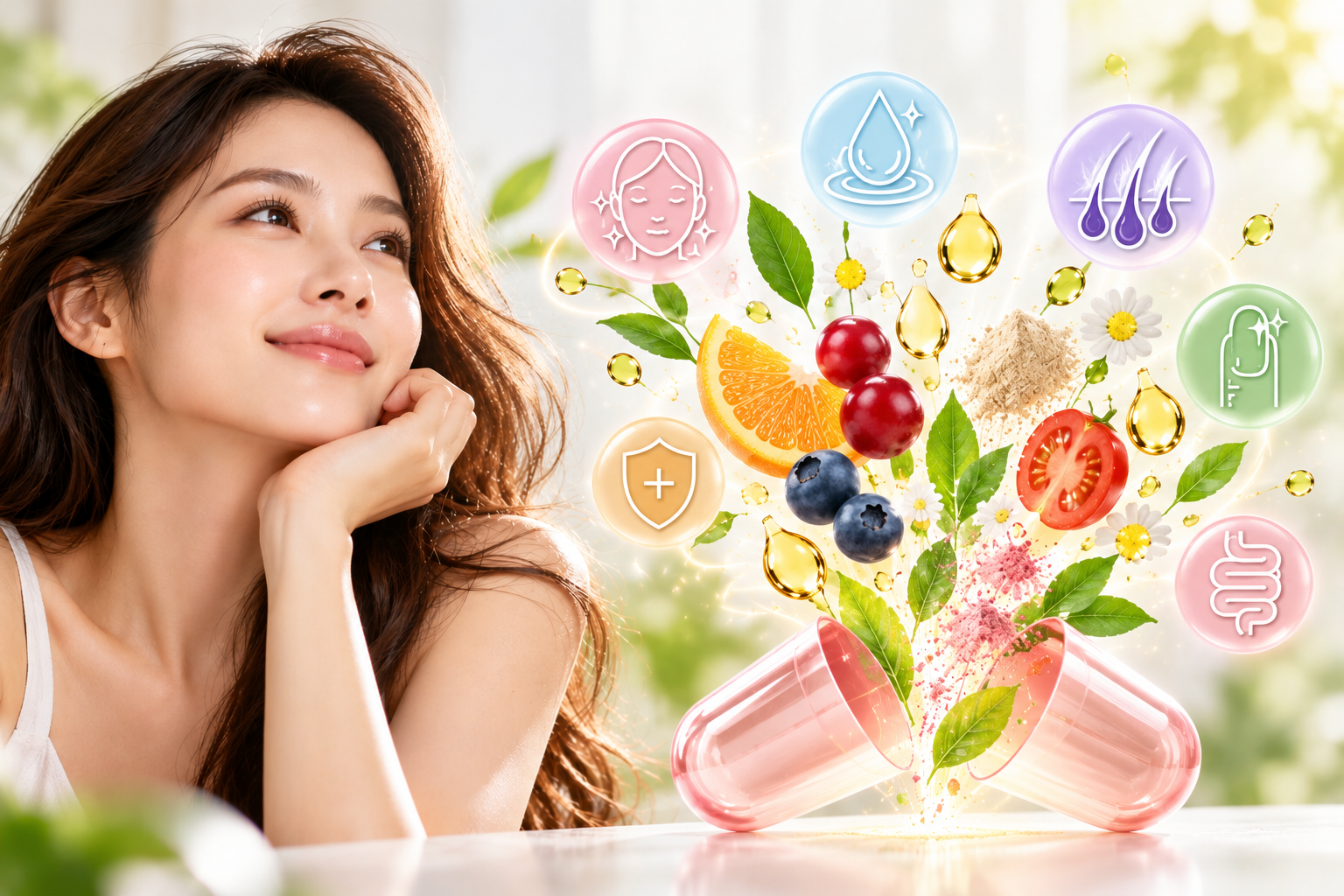
Beauty supplements have evolved beyond the traditional “one ingredient, one benefit” approach.
For years, beauty-from-within products were often built around a single hero ingredient, such as collagen for skin or biotin for hair. Today, consumers are looking for more comprehensive solutions that fit into a broader approach to beauty and wellness.
This shift is driving growing interest in multi-functional beauty supplement formulas—products designed to support several complementary beauty or wellness goals within one convenient formula.
But what exactly makes a formula multi-functional, and why are brands moving in this direction?
What Is a Multi-Functional Beauty Supplement?
A multi-functional beauty supplement combines several complementary ingredients to address more than one consumer need.
For example, instead of focusing exclusively on skin hydration, a product could be developed around:
- Skin hydration and appearance
- Skin elasticity and firmness
- Antioxidant support
- Hair and nail wellness
- Healthy aging
- Overall beauty and wellness
The goal, however, is not simply to add as many ingredients as possible.
Multi-functional does not have to mean complicated.
A well-designed formula should have a clear purpose, with each ingredient selected because it contributes to the overall product concept.
Why Is the Beauty Category Changing?
One major factor is the changing definition of beauty.
Beauty is increasingly viewed as part of overall wellness rather than something completely separate from health. Consumers may consider skin health alongside nutrition, sleep, exercise, stress management and healthy aging.
This has helped drive the growth of beauty-from-within—the concept that nutrition can form part of a broader approach to maintaining healthy-looking skin and overall appearance.
Consumers are also becoming more knowledgeable about ingredients. They may actively research ingredients, compare formulas and look for products supported by scientific evidence.
As a result, simply including a familiar ingredient may no longer be enough to differentiate a product.
From Single-Benefit to Multi-Benefit
A traditional beauty supplement may answer a simple question:
“What does this product do?”
A modern multi-functional formula can address a broader question:
“How does this product fit into my overall beauty and wellness routine?”
Consumers may not want one product for skin, another for hair, another for antioxidant support and another for healthy aging.
A thoughtfully developed multi-functional formula can potentially bring several complementary functions into one daily product.
This is particularly attractive to consumers who prefer simpler wellness routines.
The Rise of the Beauty + Wellness Consumer
The modern beauty consumer is not necessarily focused on appearance alone.
There is increasing overlap between beauty, nutrition and wellness categories. This has created product concepts that combine beauty with other areas of health and lifestyle.
For example:
Beauty + Healthy Aging
Products combining beauty-related ingredients with ingredients associated with healthy aging and cellular wellness.
Beauty + Antioxidant Support
Formulations designed around skin health alongside antioxidant-related benefits.
Beauty + Hair & Nails
Products addressing multiple visible aspects of beauty within one formula.
Beauty + Gut Health
Formulations inspired by growing interest in the relationship between gut health and skin.
Beauty + Sleep & Recovery
Products positioned around the broader relationship between rest, recovery and appearance.
These combinations allow brands to address a broader consumer need instead of competing solely within one ingredient category.
The Science Behind Multi-Ingredient Formulas
Multi-functional formulation is not simply about combining several popular ingredients.
Ingredients can interact with one another, and the final product needs to be evaluated as a complete formulation.
Formulators may need to consider:
- Ingredient compatibility
- Appropriate dosage
- Solubility and absorption
- Stability
- Sensory characteristics
- Packaging
- Regulatory considerations
An ingredient that performs well on its own may behave differently when combined with several other active ingredients.
This is why formulation expertise becomes increasingly important as products become more sophisticated.
Choosing Complementary Ingredients
A strong multi-functional formula should begin with a clear product objective.
Suppose a brand wants to develop a supplement positioned around skin health and healthy aging.
Rather than selecting ingredients based purely on popularity, the formulation team could identify several complementary areas:
Skin appearance
Ingredients may be selected based on evidence related to skin elasticity, firmness or other relevant outcomes.
Hydration
Ingredients may support skin moisture and hydration-related outcomes.
Antioxidant support
Selected compounds may provide antioxidant activity or have evidence related to oxidative stress.
Healthy aging
Additional ingredients may support broader concepts such as cellular wellness, depending on the evidence and intended positioning.
This approach creates a more logical formulation architecture.
The result is not simply a list of ingredients. It becomes a product with a clear story.
Dosage and Format Matter
One of the biggest challenges with multi-functional formulas is dosage.
Every additional active ingredient requires space, which can be particularly challenging for capsules and tablets.
A formula containing several high-dose ingredients may result in a large serving size, reducing convenience for consumers.
This is why the dosage form should be considered early in product development.
Capsules, tablets, gummies, powders, sachets and liquids each offer different opportunities and formulation constraints.
A well-designed product needs to balance:
Function + dosage + format + convenience.
For example, a powder sachet may provide greater flexibility for a larger total serving size, while a capsule product may offer convenience for consumers who prefer a familiar supplement format.
Avoiding the “Kitchen Sink” Formula
Adding more ingredients does not automatically create a better product.
A formula containing 15 or 20 ingredients may look impressive on a label, but if some are included at poorly supported levels or have little relevance to the product concept, the additional complexity may not provide meaningful value.
A better approach is to work backwards from the consumer need.
Ask:
Who is the product for?
What is the primary benefit?
What secondary benefits make sense?
Which ingredients have relevant evidence?
Can they be delivered at appropriate levels?
Will the finished formula remain stable?
These questions help transform a collection of ingredients into a purposeful formulation.
Multi-Functional Does Not Mean Multi-Claim
A product may contain ingredients associated with several areas of research, but that does not mean every possible benefit should appear in its marketing.
Product communication should reflect the available evidence and comply with applicable regulatory requirements in the target market.
This is particularly important for beauty supplements, where terms such as “anti-aging,” “rejuvenation” or “repair” can create expectations that go beyond what the science supports.
A credible product strategy should align:
Science → Formulation → Evidence → Communication
When these elements work together, the product story becomes stronger and more trustworthy.
Convenience Is Part of the Product Experience
Consumers today may already be taking vitamins, minerals, probiotics, beauty supplements and other wellness products.
Managing multiple products every day can become inconvenient.
A multi-functional supplement offers an opportunity to simplify the routine.
A single daily sachet, capsule serving, gummy or ready-to-drink format can potentially bring several complementary functions together.
For brands, this means convenience can become part of the product’s value proposition, not simply a packaging decision.
What Does the Future Look Like?
The next generation of beauty supplements is likely to become increasingly multi-dimensional.
Rather than keeping skin, hair, nutrition and healthy aging in separate categories, brands may increasingly develop products that sit at the intersection of several wellness needs.
We may see more concepts built around:
- Skin + Longevity
- Beauty + Cellular Wellness
- Hair + Skin + Nails
- Beauty + Gut Health
- Beauty + Sleep & Recovery
- Beauty + Active Aging
This reflects a broader consumer shift toward products that fit into their whole lifestyle, rather than products designed around one isolated benefit.
The Bottom Line
Beauty supplements are moving toward multi-functional formulas because consumers are becoming more sophisticated, wellness categories are converging, and convenience is increasingly important.
However, multi-functional formulation should not mean simply adding more ingredients.
The strongest products are likely to be those built around a clear consumer need, supported by relevant science and delivered in a convenient, stable and enjoyable format.
For nutraceutical brands, the opportunity is to move beyond the “one ingredient, one benefit” model and develop purposeful formulations that support multiple dimensions of beauty and wellness.
At Novaxis, this is where formulation expertise can make a difference—transforming ingredient possibilities into science-led, practical products that deliver a clear proposition for brands and a convenient experience for consumers.