


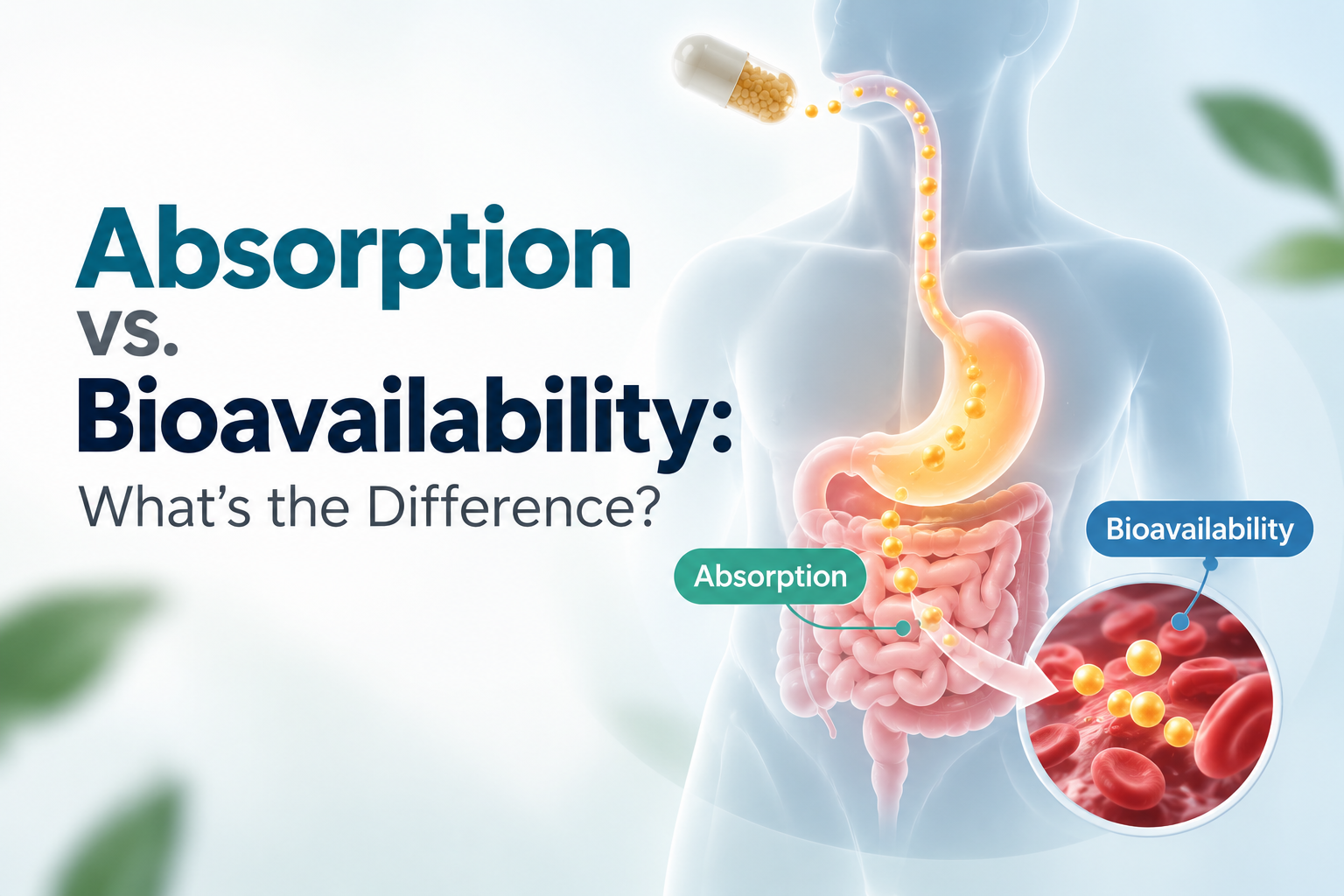
When developing or choosing a supplement, you may come across terms such as absorption and bioavailability. They are often used interchangeably, but they describe different stages of what happens to an ingredient after you consume it.
Understanding the difference matters because simply putting an ingredient into a capsule, powder, gummy, or beverage does not necessarily mean the body can effectively use it.
A well-designed supplement considers not only what ingredient is included, but also how well that ingredient can be absorbed and how much ultimately becomes available for the body to use.
What Is Absorption?
Absorption refers to the movement of a substance from the digestive tract into the body’s circulation.
After you consume a supplement, the ingredient first has to pass through the digestive process. Depending on the ingredient, it may be exposed to stomach acid, digestive enzymes, bile, and other conditions that can affect its stability.
Once an ingredient reaches the appropriate part of the gastrointestinal tract, it may cross the intestinal lining and enter the bloodstream.
In simple terms:
Absorption = getting an ingredient from the digestive tract into circulation.
However, absorption is only part of the story.
An ingredient may be absorbed into the bloodstream, but that does not automatically mean that a large amount reaches the tissues where it is needed or remains available for the body to use.
That is where bioavailability becomes important.
What Is Bioavailability?
Bioavailability generally refers to the proportion of a consumed substance that reaches systemic circulation in an available form and can potentially exert its intended effect.
Think of it this way:
Absorption asks: “Did it get into the bloodstream?”
Bioavailability asks: “How much of it actually became available to the body?”
Bioavailability can be influenced by several factors, including digestion, absorption, metabolism and the chemical form of an ingredient.
For example, an ingredient may be absorbed through the intestine but then undergo significant metabolism before reaching systemic circulation. In that situation, the amount ultimately available to the body may be lower than the original amount consumed.
Absorption and Bioavailability Are Connected—but Not the Same
The two concepts are closely related, but they should not be treated as identical.
Consider a simple example.
Imagine taking 100 mg of a nutrient.
If 60 mg passes through the intestinal barrier and enters circulation, absorption has occurred.
But if a substantial portion is subsequently metabolized before becoming systemically available, the amount available to the body may be considerably lower.
This is why ingredient dosage alone does not tell the whole story.
Two products could contain the same amount of an ingredient but potentially deliver different amounts to the body depending on the ingredient form, formulation and other factors.
What Can Affect Absorption?
Several factors can influence how well an ingredient is absorbed.
The chemical form of the ingredient
Different forms of the same nutrient or active compound can behave differently in the body.
For minerals, for example, different salt or chelated forms may have different physicochemical characteristics.
For botanical ingredients, the extraction method and standardization can also influence the composition and characteristics of the final ingredient.
Choosing an appropriate ingredient form is therefore an important part of formulation.
Solubility
An ingredient generally needs to be sufficiently soluble under the relevant conditions before it can be effectively absorbed.
Poorly soluble compounds can present formulation challenges because dissolution may limit how much of the ingredient becomes available for absorption.
This is particularly relevant for certain fat-soluble compounds and other poorly water-soluble ingredients.
Food and meal timing
Whether an ingredient is consumed with food can influence its absorption.
Some compounds may be better absorbed when taken with a meal, while others may be affected by specific components of food.
For certain fat-soluble nutrients and compounds, dietary fat can play an important role in absorption.
This means that the recommended directions for use are not simply a marketing consideration—they can be relevant to how a formulation performs.
Other ingredients
Ingredients do not always behave independently.
Some nutrients and compounds can interact with one another during digestion or absorption. These interactions may enhance, reduce, or otherwise alter the availability of an ingredient.
This is one reason why formulation compatibility matters when developing multi-ingredient supplements.
The individual’s physiology
Absorption and bioavailability can also vary between individuals.
Factors such as age, digestive function, nutritional status, genetics and differences in metabolism may influence how the body handles particular compounds.
As a result, laboratory or clinical findings should always be interpreted in the context of the specific ingredient, dose, formulation and study population.
What Is the Role of Formulation?
This is where supplement formulation becomes particularly important.
A formulation is not simply a list of ingredients. The way ingredients are combined and delivered can influence their physical and chemical properties, stability, dissolution and ultimately their ability to become available to the body.
Depending on the ingredient, formulation strategies may include:
- Selecting an appropriate ingredient form
- Improving solubility or dispersion
- Using delivery technologies
- Combining ingredients strategically
- Protecting sensitive compounds from degradation
- Optimizing the dosage form
- Considering interactions between ingredients
- Designing appropriate storage and packaging conditions
For example, a poorly soluble ingredient may require a different approach from a water-soluble vitamin. A sensitive botanical extract may also require different considerations from a stable mineral.
There is therefore no single “best” formulation technology for every ingredient.
Does Higher Bioavailability Always Mean Better?
Not necessarily.
It is tempting to assume that higher bioavailability automatically means a better supplement, but the relationship is more nuanced.
The appropriate amount of an ingredient reaching the body depends on the ingredient, dose, intended use and available evidence.
A formulation should not simply aim to maximize exposure without considering safety, efficacy and the conditions under which the ingredient has been studied.
This is particularly important when evaluating marketing claims around “enhanced absorption” or “higher bioavailability.”
A credible formulation approach should connect improved delivery characteristics with meaningful evidence rather than treating bioavailability as a marketing buzzword.
How Is Bioavailability Studied?
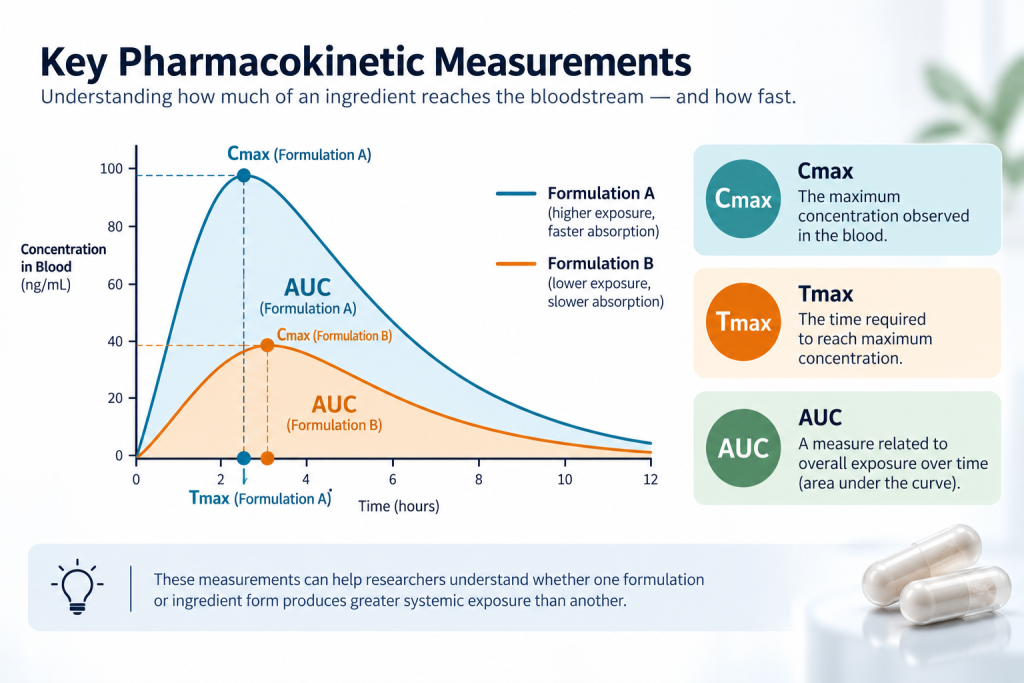
Researchers can use different approaches to evaluate how an ingredient behaves in the body.
One common approach is to compare blood concentrations after administration of different formulations or ingredient forms.
Researchers may examine measurements such as:
- Cmax – the maximum concentration observed in the blood
- Tmax – the time required to reach maximum concentration
- AUC (area under the curve) – a measure related to overall exposure over time
These measurements can help researchers understand whether one formulation or ingredient form produces greater systemic exposure than another.
However, pharmacokinetic improvements should not automatically be interpreted as proof of greater clinical benefit.
The strongest evidence comes from connecting improved exposure with meaningful outcomes in appropriate human studies.
Why Bioavailability Matters in Nutraceutical Formulation
For nutraceutical brands, bioavailability is more than a scientific concept. It can influence how a product is designed and positioned.
A strong formulation process considers several questions:
Can the ingredient remain stable in the finished product?
Can it dissolve appropriately?
Is the selected form suitable for the intended dosage format?
Could other ingredients affect its absorption?
Is there evidence supporting the selected delivery approach?
Has the formulation been evaluated under appropriate conditions?
These questions become increasingly important as brands move toward more sophisticated products containing multiple active ingredients.
Instead of simply asking, “How much of this ingredient can we put into the product?”, formulators increasingly need to ask:
“How can we design the product so the ingredient is delivered in an appropriate and evidence-based way?”
Absorption and bioavailability are related, but they are not the same.
Absorption describes the movement of an ingredient from the digestive tract into circulation. Bioavailability goes further by considering the proportion that ultimately becomes available to the body in a usable form.
For supplement development, both concepts matter.
A scientifically thoughtful formulation looks beyond the ingredient label and considers ingredient form, solubility, stability, interactions, dosage and delivery format, together with the available evidence.
Ultimately, good nutraceutical formulation is not simply about putting more ingredients into a product. It is about creating a product in which the right ingredients, in the right forms and at appropriate levels, are delivered in a way that makes scientific and commercial sense.
At Novaxis, this science-led approach can help brands move from an ingredient concept to a thoughtfully designed nutraceutical product—balancing formulation considerations, functionality and consumer experience.