


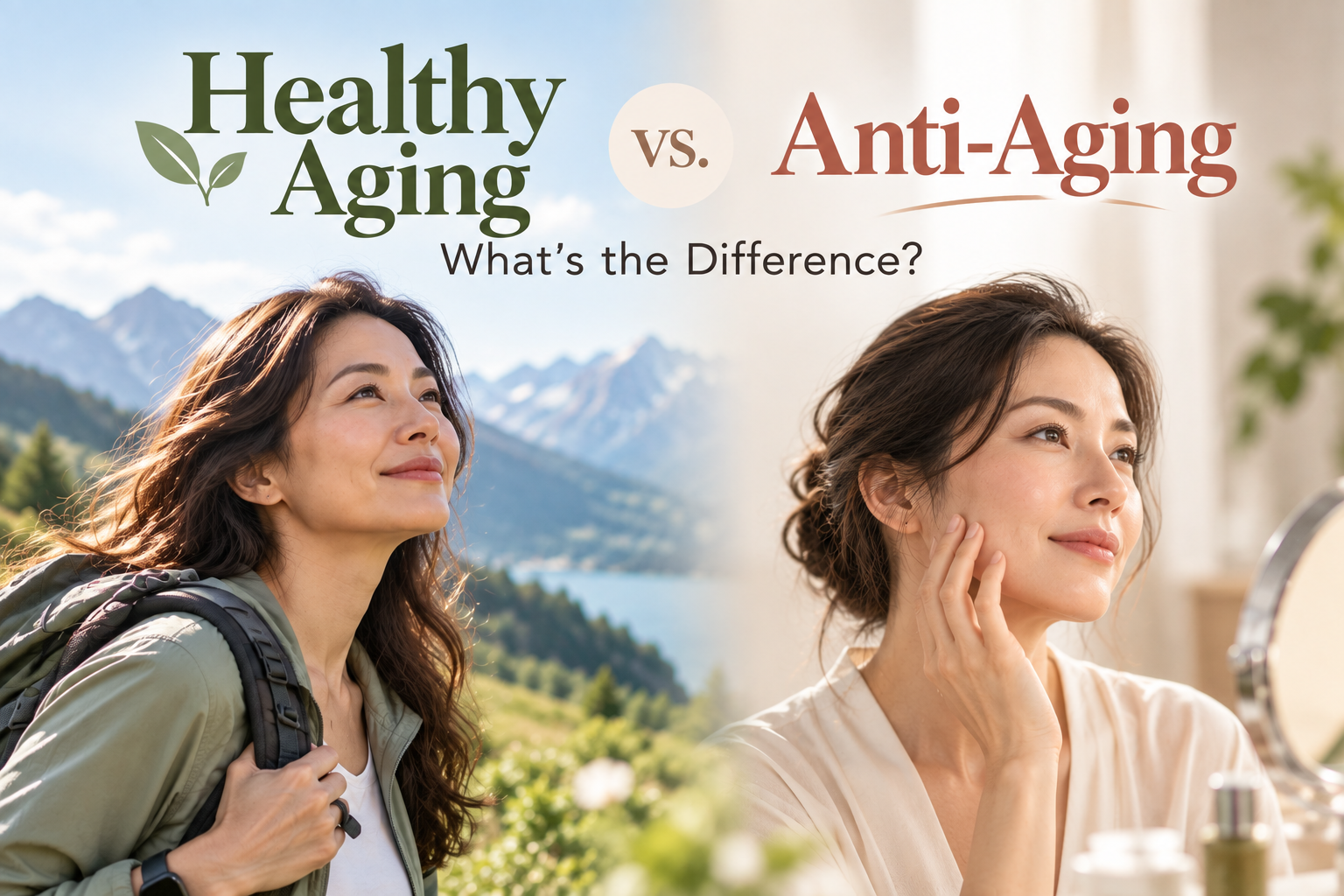
Aging is inevitable. But how we think about aging is changing.
For years, the wellness industry has largely focused on “anti-aging”—reducing visible signs of aging, reversing age-related changes, or trying to make people look and feel younger.
Today, a broader concept is gaining attention: healthy aging.
Rather than asking, “How can we stop aging?”, consumers and health brands are increasingly asking:
“How can we maintain health, function and quality of life as we get older?”
This shift is influencing everything from skincare and nutrition to supplements, functional foods and longevity-focused products.
But what exactly is the difference between anti-aging and healthy aging? And what does this mean for the development of modern nutraceutical products?
What Is Anti-Aging?
The term anti-aging traditionally refers to strategies intended to reduce or counteract visible or functional changes associated with getting older.
In the supplement and beauty industries, anti-aging products may focus on areas such as:
- Skin appearance
- Fine lines and wrinkles
- Skin elasticity
- Antioxidant protection
- Energy and vitality
- Cognitive function
- Muscle health
The concept is highly consumer-friendly because it speaks directly to a familiar desire: looking and feeling younger.
However, aging is not a single process. It involves multiple biological changes occurring across different tissues and systems.
This is why the modern conversation is increasingly moving beyond the idea of simply “fighting” aging.
What Is Healthy Aging?
Healthy aging takes a broader approach.
Instead of trying to eliminate aging itself, healthy aging focuses on maintaining physical, mental and functional well-being throughout the later stages of life.
The World Health Organization describes healthy ageing in terms of developing and maintaining functional ability that enables well-being in older age.
This means the focus is not simply on how old someone is, but on how well they are able to live, move, think and participate in everyday life.
Healthy aging can therefore involve multiple areas, including:
- Maintaining muscle strength and physical function
- Supporting cardiovascular health
- Maintaining cognitive function
- Supporting bone health
- Maintaining energy and vitality
- Supporting metabolic health
- Maintaining skin and connective tissue health
- Supporting healthy sleep
- Preserving independence and quality of life
This broader perspective is changing how consumers think about supplements and wellness.
Anti-Aging vs. Healthy Aging
The easiest way to understand the difference is to look at the underlying mindset.
Anti-Aging | Healthy Aging |
Focuses on counteracting signs of aging | Focuses on maintaining function as we age |
Often associated with appearance | Encompasses physical, mental and functional health |
“Look younger” | “Age well” |
Often targets specific visible concerns | Takes a broader, multi-system approach |
Focuses on reversing or reducing age-related changes | Focuses on maintaining health and quality of life |
The two concepts are not necessarily opposites.
An ingredient used in a beauty supplement, for example, may support skin-related goals while also fitting into a broader healthy-aging strategy.
The key difference is how the product and its benefits are framed.
Why Is Healthy Aging Becoming More Important?
One reason is demographic change.
People are living longer, while consumers are also becoming more interested in maintaining their health and independence for as long as possible.
This has created growing interest in products designed not simply for older adults, but for people who want to prepare for healthy aging earlier in life.
The idea of healthy aging is therefore no longer limited to someone in their 60s or 70s.
A consumer in their 30s or 40s may already be thinking about:
- Maintaining muscle
- Supporting brain health
- Protecting skin from environmental stress
- Maintaining energy
- Supporting cardiovascular health
- Building healthy lifestyle habits
This creates a much larger opportunity for the nutraceutical industry.
Healthy Aging Is About Function, Not Just Appearance
One of the biggest changes in the longevity conversation is the move from appearance-focused aging toward function-focused aging.
Looking younger may remain important, but consumers are increasingly interested in questions such as:
Can I stay physically active?
Can I maintain my strength?
Can I stay mentally sharp?
Can I maintain my independence?
Can I continue doing the activities I enjoy?
This creates opportunities for supplement categories that support different aspects of healthy aging.
For example, products may be developed around muscle health, cognitive wellness, cardiovascular support, bone health, energy metabolism or beauty-from-within.
Rather than treating aging as one problem, healthy aging recognizes it as a multidimensional process.
The Role of Muscle in Healthy Aging
Muscle health is becoming an increasingly important part of the healthy-aging conversation.
As people age, maintaining muscle mass and strength becomes more challenging. Physical activity, adequate protein intake and appropriate nutrition all play important roles in supporting muscle health.
This has contributed to growing interest in ingredients associated with:
- Muscle protein synthesis
- Exercise performance
- Recovery
- Strength
- Physical function
Creatine is one example of an ingredient that has traditionally been associated with sports nutrition but is increasingly being discussed in the context of broader healthy aging.
This illustrates an important trend: categories that were once separated are beginning to converge.
Sports nutrition and healthy aging, for example, can share common goals around maintaining muscle, strength and physical function.
Mitochondria and Cellular Energy
Another area attracting attention in healthy-aging research is mitochondrial function.
Mitochondria are often described as the energy-producing structures within cells. They play an essential role in cellular energy metabolism.
As part of the aging process, changes in mitochondrial function have been investigated in relation to various aspects of aging biology.
This has led to interest in nutrients and compounds involved in energy metabolism and mitochondrial health.
For nutraceutical brands, mitochondrial health represents an opportunity to communicate the concept of aging at a cellular level, rather than focusing only on external signs.
However, as with any emerging longevity category, product positioning should be based on the quality and relevance of available evidence for the specific ingredient and intended benefit.
Oxidative Stress and Inflammation
Oxidative stress and chronic low-grade inflammation are also frequently discussed in the science of aging.
The body naturally produces reactive molecules as part of normal metabolism, while antioxidant systems help maintain balance.
At the same time, researchers have investigated how persistent inflammatory processes may be associated with age-related changes.
This has created interest in antioxidant-rich botanicals, vitamins, minerals and other bioactive compounds.
However, this does not mean that simply consuming more antioxidants automatically prevents aging.
The science is more complex.
For supplement formulation, the more meaningful question is:
What ingredient, at what dose, in what form, has evidence supporting a particular health objective?
This is where scientifically responsible formulation becomes important.
From “Anti-Aging” to “Longevity”
Healthy aging is closely connected to another rapidly growing concept: longevity.
While anti-aging often focuses on reducing the signs of aging, longevity focuses more broadly on extending the years of life—and increasingly, the years lived in good health.
This has led to growing interest in concepts such as:
- Cellular health
- Mitochondrial function
- Metabolic health
- Muscle health
- Cognitive health
- Healthy inflammation response
- Sleep and recovery
- Physical resilience
The result is a new generation of products positioned around long-term health rather than short-term transformation.
What Does This Mean for Supplement Formulation?
The shift toward healthy aging presents an interesting challenge for product developers.
Aging involves multiple biological systems, so a single ingredient may not address every aspect of the consumer’s needs.
This has contributed to the rise of multi-functional formulations.
For example, a healthy-aging product could potentially combine ingredients targeting different complementary areas such as muscle, energy metabolism and cognitive wellness.
However, simply adding more ingredients does not necessarily create a better formula.
A well-designed product should consider:
- Scientific evidence for each ingredient
- Appropriate dosage
- Ingredient compatibility
- Bioavailability
- Stability
- Sensory properties
- Consumer convenience
- Intended positioning
- Regulatory requirements
The objective should be to create a purposeful formulation, rather than a long ingredient list.
Healthy Aging Is Also a Consumer Mindset
Perhaps the biggest difference between anti-aging and healthy aging is psychological.
Anti-aging can imply that getting older is something that needs to be fought.
Healthy aging presents a different perspective:
Aging is natural. The goal is to age well.
This makes the category more inclusive.
A healthy-aging product does not necessarily need to be marketed only to older consumers. It can appeal to people at different life stages who want to maintain their health and function over time.
This creates opportunities for brands to develop products around concepts such as active longevity, cellular wellness, healthy vitality and everyday resilience.
The Future of Healthy Aging
The healthy-aging category is likely to become increasingly sophisticated.
Instead of a single “longevity supplement,” we can expect more targeted products addressing specific aspects of aging and quality of life.
These may include:
Muscle & mobility
Products supporting strength, recovery and physical function.
Brain & cognitive wellness
Formulations focused on memory, focus and cognitive performance.
Beauty & skin longevity
Products supporting skin health from within.
Metabolic wellness
Products supporting healthy metabolic function and energy management.
Cellular & mitochondrial health
Products built around cellular energy and resilience.
The result could be a more personalized approach to healthy aging, where consumers select products based on their individual goals rather than simply their chronological age.
The Bottom Line
Anti-aging and healthy aging are related, but they represent different approaches.
Anti-aging traditionally focuses on reducing or counteracting signs of getting older, often with an emphasis on appearance or specific age-related changes.
Healthy aging takes a broader view. It focuses on maintaining physical, cognitive and functional health throughout the aging process.
For the nutraceutical industry, this shift represents more than a change in terminology. It is creating new opportunities for products that support muscle health, cognitive wellness, cellular function, beauty-from-within and overall vitality.
The future of aging may not be about trying to stay young forever.
It may be about staying strong, active, healthy and capable for as long as possible.
For brands developing the next generation of nutraceutical products, that change in perspective opens the door to more meaningful, science-led and multi-dimensional approaches to healthy aging.