


In today’s competitive health and wellness market, antioxidants remain one of the most widely used positioning strategies. Yet many products still rely on a single “hero ingredient” — often assuming that higher dosage alone translates to better performance.
For formulators and brand owners, this approach is increasingly outdated.
The human body does not rely on one antioxidant alone. Instead, it operates through a highly coordinated antioxidant system — a network of enzymes, nutrients, and cellular processes working together. Understanding this system is key to developing products that are not only marketable, but also scientifically credible and effective.
What Is the Antioxidant System?
At its core, the antioxidant system protects the body against oxidative stress, a condition where free radicals overwhelm the body’s defenses and begin damaging cells, proteins, and DNA.
This imbalance is driven by modern lifestyle factors such as:
- Environmental pollution
- UV exposure
- Poor dietary habits
- Sleep deprivation
- Chronic stress
Over time, oxidative stress impacts:
- Cellular efficiency
- Energy production
- Skin health
- Overall resilience
To manage this, the body relies on a multi-layered defense system, not a single compound acting in isolation.
The 3 Layers of the Antioxidant Defense System
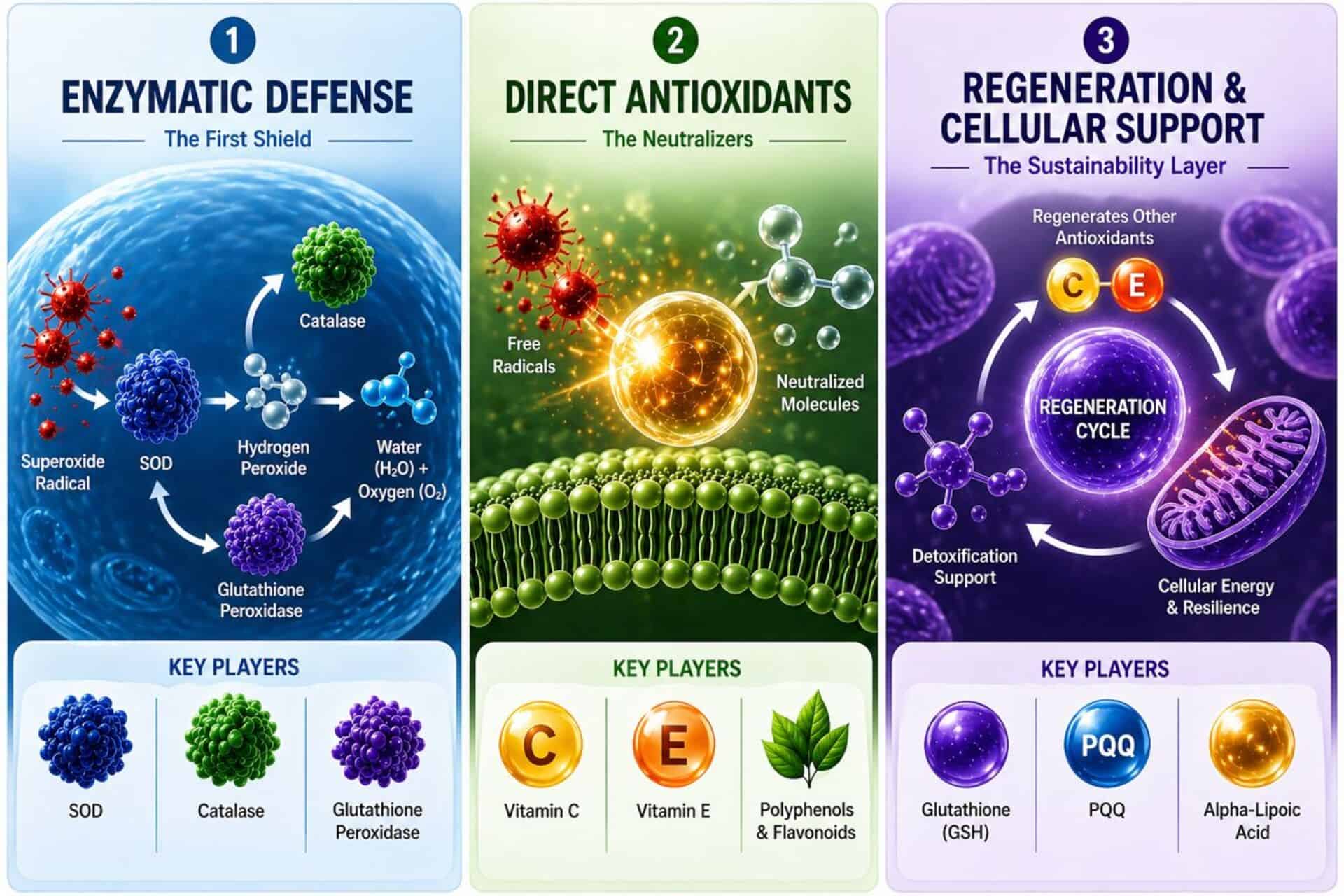
Enzymatic Defense: The First Shield
This is the body’s primary line of defense, designed to neutralize harmful molecules before they can cause widespread damage.
Key enzymes include:
- superoxide dismutase (SOD)
- Catalase
- Glutathione peroxidase
These enzymes work in sequence to convert reactive molecules into harmless substances like water and oxygen.
From a formulation perspective, this highlights an important point:
Supporting enzyme activity requires cofactors such as zinc, copper, and selenium — not just standalone antioxidants.
Direct Antioxidants: The Neutralizers
This layer includes commonly used ingredients such as:
- Vitamin C
- Vitamin E
- Polyphenols and flavonoids
These compounds directly neutralize free radicals and protect cellular structures.
However, once they perform their function, they become oxidized. Without a regeneration mechanism, their effectiveness is temporary — which is why high-dose, single-ingredient strategies often fall short.
Regeneration & Cellular Support: The Missing Link
This is the most critical — yet often overlooked — layer in antioxidant formulation.
It ensures antioxidants are:
- Recycled
- Regenerated
- Sustained over time
Key examples include:
- glutathione
- Pyrroloquinoline quinone
- Alpha-lipoic acid
This layer connects antioxidant activity with cellular energy and metabolic function, making it essential for long-term efficacy.
Why Multi-Layer Formulation Matters
Focusing on a single antioxidant may simplify marketing, but it does not reflect biological reality.
The antioxidant system is interdependent:
- Enzymes rely on nutrient cofactors
- Direct antioxidants rely on regeneration
- Cellular energy influences the entire system
A formulation that supports only one layer will always deliver limited and short-term results.
In contrast, a multi-layer approach enables:
- Synergistic activity across pathways
- Sustained antioxidant effects
- Stronger product differentiation in crowded markets
Common Formulation Gaps in the Market
Many products still fall into predictable traps:
- Over-reliance on a single ingredient (e.g., only Vitamin C or glutathione)
- Lack of enzyme support
- No regeneration strategy
- Positioning based on “high dose” instead of “functional synergy”
These gaps present a clear opportunity for brands to move toward more advanced, system-based solutions.
From Ingredient Marketing to System Design
Consumer expectations are evolving. Instead of generic claims like “anti-aging” or “high antioxidant,” there is increasing demand for:
- Cellular health support
- Energy and vitality
- Long-term wellness solutions
This shift aligns directly with antioxidant system-based formulation, which reflects how the body actually functions.
Final Thoughts
Antioxidants are not just individual ingredients — they are part of a dynamic biological system.
From enzymes like superoxide dismutase, to nutrients like Vitamin C, to regenerators like glutathione and Pyrroloquinoline quinone, every layer plays a role.
The future of formulation lies in supporting this system holistically, not isolating it.
Build Smarter Antioxidant Formulations with Novaxis
If you’re developing your next antioxidant product, the question is no longer:
“Which ingredient should we highlight?”
But rather:
“How do we design a system that actually works?”
At Novaxis, we help brands:
- Translate science into market-ready formulations
- Design multi-layer antioxidant systems
- Create clear, differentiated positioning in competitive categories
Whether you’re launching a new product or upgrading an existing one, we can support you from concept to commercialization.
Let’s build your next antioxidant formula — with a system, not just a label.