


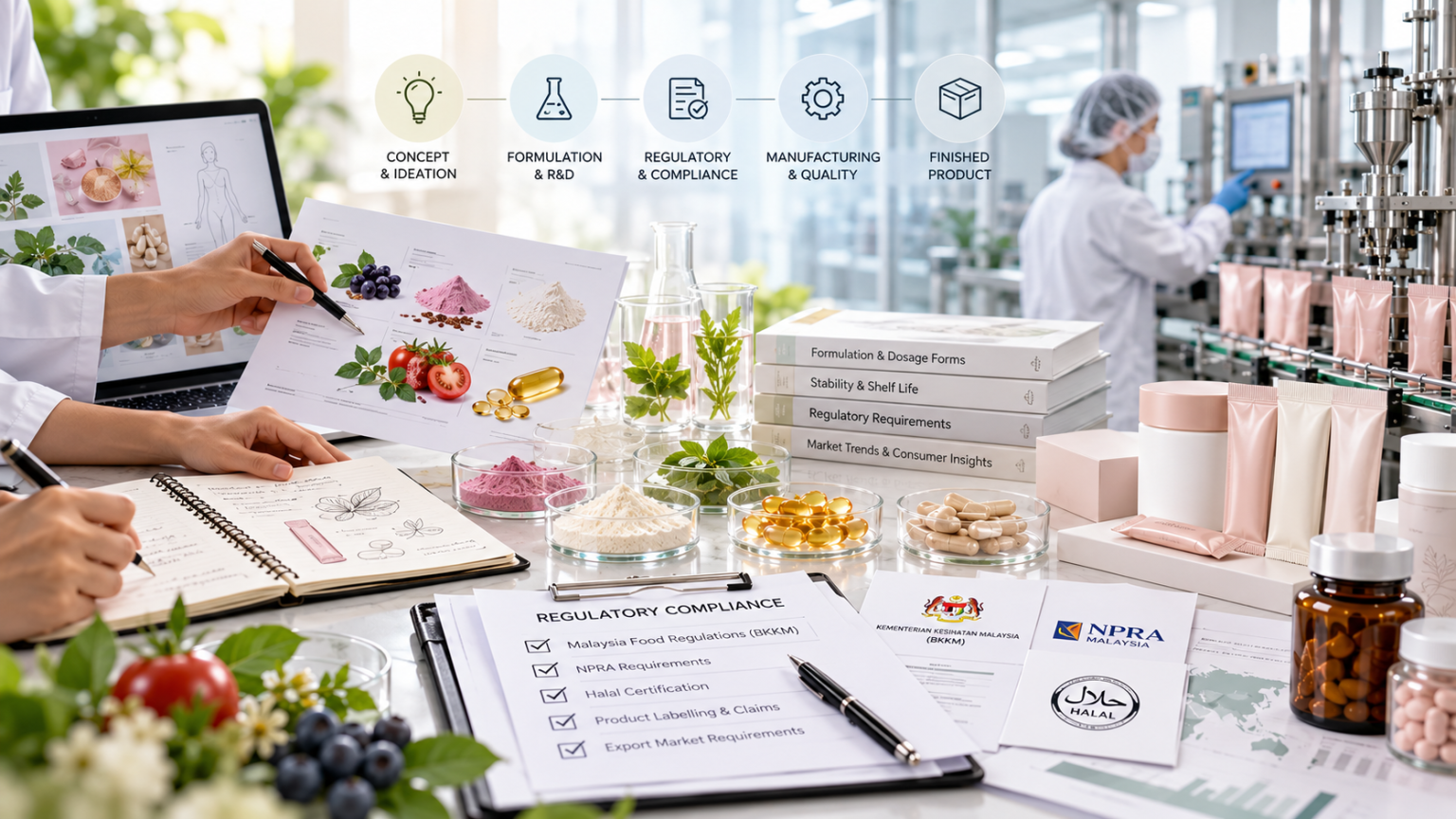
Launching a supplement product involves much more than choosing a few ingredients and putting them into a capsule or sachet.
From formulation and ingredient sourcing to manufacturing, quality control, packaging and regulatory considerations, there are many decisions that can influence the success of a product.
For brands, one of the most important decisions is choosing the right nutraceutical manufacturing partner.
The right partner can help turn an idea into a commercially viable product. The wrong one can create challenges with formulation, quality, timelines, communication and cost.
So, what should brands look for when evaluating a nutraceutical manufacturer?
Look Beyond Manufacturing Capacity
Manufacturing capability is important, but it should not be the only consideration.
Two manufacturers may both be able to produce capsules or powders, yet offer very different levels of support during product development.
A strong manufacturing partner should ideally understand the process from concept to finished product, including:
- Ingredient selection
- Formula development
- Dosage considerations
- Ingredient compatibility
- Stability
- Manufacturing
- Quality control
- Packaging
- Regulatory requirements
This is particularly important for brands that do not have an in-house R&D or formulation team.
A manufacturer that can support development—not just production—can make the process significantly more efficient.
Evaluate Their Formulation Expertise
A good nutraceutical formula is more than a list of popular ingredients.
The formulation needs to work as a complete system.
For example, developers may need to consider:
Dosage
Are the ingredients included at meaningful and appropriate levels?
Compatibility
Can the ingredients be combined without creating formulation or stability problems?
Bioavailability
Can the selected ingredient form be effectively delivered?
Stability
Will the active ingredients remain within acceptable specifications throughout the intended shelf life?
Sensory properties
Will the product taste, smell and feel acceptable to consumers?
Format
Is a capsule, powder, sachet, gummy or liquid appropriate for the formula?
These considerations require more than basic manufacturing capability.
They require formulation knowledge and development experience.
Ask About Ingredient Sourcing
Ingredient quality directly affects the finished product.
When evaluating a manufacturing partner, brands should understand how ingredients are sourced and qualified.
Important questions may include:
- Where are the ingredients sourced from?
- Are suppliers qualified?
- Are raw materials tested?
- Is there documentation for identity and purity?
- Are botanical extracts standardized?
- Can the manufacturer provide relevant certificates and specifications?
- How is raw material consistency managed?
For botanical ingredients in particular, the source, extraction method and standardization can influence the composition of the final ingredient.
A reliable manufacturing partner should have a structured approach to supplier and raw-material qualification.
Understand Their Quality System
Quality should not be treated as a final inspection before products leave the factory.
It should be built into the entire manufacturing process.
Brands should look for manufacturers operating under appropriate Good Manufacturing Practice (GMP) standards and relevant quality systems for their markets.
Depending on the product and market, quality processes may cover:
- Raw material testing
- In-process controls
- Finished product testing
- Microbiological testing
- Contaminant testing
- Stability testing
- Batch documentation
- Traceability
- Complaint handling
The exact requirements will vary depending on the market, product category and regulatory framework.
The important question is whether the manufacturer has a systematic and documented approach to quality.
Consider Regulatory Knowledge
A formula that looks excellent on paper may still face challenges if it is not suitable for the intended market.
Different countries can have different requirements for:
- Permitted ingredients
- Maximum levels
- Health claims
- Labelling
- Product registration
- Advertising
- Product classification
This means regulatory considerations should ideally be discussed before finalizing the formulation.
A manufacturing partner with experience in the relevant market can help brands identify potential issues early.
For companies planning to launch across multiple countries, this becomes even more important.
Make Sure They Can Support Your Product Format
The right manufacturer should have capabilities that match the product you want to develop.
Different formats create different technical requirements.
Capsules and Tablets
These are familiar and convenient but may have limitations when a formula requires high doses or large quantities of active ingredients.
Powders and Sachets
These can provide greater flexibility for larger serving sizes and are increasingly popular for functional nutrition and beverage-style products.
Gummies
Gummies offer a consumer-friendly format but can present challenges around dosage, taste, texture, stability and sugar or sweetener systems.
Liquids and Ready-to-Drink Products
These may offer a convenient consumer experience but can require additional considerations around stability, preservation and packaging.
The important point is that the format should work with the formula, rather than forcing the formula into a format that creates unnecessary problems.
Ask About Minimum Order Quantities
Minimum order quantity, or MOQ, is an important commercial consideration—particularly for startups and emerging brands.
A manufacturer may have excellent capabilities but require volumes that are too large for a new product launch.
Before starting development, clarify:
- Minimum production quantity
- Pilot batch options
- Sampling process
- Scale-up requirements
- Packaging MOQ
- Ingredient MOQ
- Lead times
Understanding these requirements early can help prevent unexpected costs and delays later.
Evaluate Communication
This point is often underestimated.
Product development involves multiple stages and decisions. Poor communication can create unnecessary delays and misunderstandings.
A good manufacturing partner should be able to communicate clearly about:
- Formulation progress
- Ingredient availability
- Samples
- Testing
- Production timelines
- Documentation
- Changes or delays
You should also know who your main point of contact is.
A technically capable manufacturer that is difficult to communicate with can become a significant challenge during a product launch.
Ask About Development and Sampling
Before committing to a commercial production run, brands should understand how the development process works.
Ask whether the manufacturer can provide:
- Initial formulation proposals
- Prototype samples
- Sample revisions
- Sensory evaluation
- Stability assessment
- Pilot production
- Scale-up support
This is particularly important for products such as gummies, powders and functional beverages, where taste and texture can strongly influence consumer acceptance.
The first formulation is rarely the final formulation.
A structured development process allows the product to be refined before commercial production.
Consider Scalability
A manufacturing partner should ideally be able to support the brand beyond its first production run.
A product may begin with a relatively small launch and grow significantly if it performs well.
This raises an important question:
Can the manufacturer scale with you?
Consider whether they have the capacity and systems to support:
- Larger production volumes
- Additional SKUs
- New product formats
- New markets
- Packaging changes
- Ongoing quality requirements
Choosing a partner only for today’s requirements may create problems when the business grows.
Look at Their Approach to Custom Formulation
Not every brand needs a completely custom formula.
Some companies may prefer an existing formulation that can be adapted for their market, while others may want to develop something highly differentiated.
It is useful to understand whether the manufacturer offers:
Ready-to-market formulations
For brands that want speed and simplicity.
Customized formulations
For brands that want to modify an existing concept.
Fully custom development
For brands looking to create a unique product from the ground up.
The right option depends on the brand’s budget, timeline, target consumer and differentiation strategy.
Don’t Choose Based on Price Alone
Cost will always matter, but the lowest quotation is not necessarily the lowest-cost solution in the long term.
A low initial price may not include:
- Multiple formulation revisions
- Testing
- Packaging development
- Regulatory support
- Stability work
- Additional documentation
- Small-batch development
Brands should therefore compare total project value, rather than looking only at the manufacturing price per unit.
A slightly higher initial investment may be worthwhile if it reduces formulation problems, delays or product quality issues later.
A Practical Checklist
Before choosing a nutraceutical manufacturing partner, ask:
Area | Questions to Consider |
Formulation | Can they develop or customize formulas? |
Ingredients | How are raw materials sourced and qualified? |
Quality | What quality systems and testing are in place? |
Manufacturing | What dosage forms can they produce? |
Regulatory | Do they understand the target market? |
Sampling | Can they provide prototypes and revisions? |
MOQ | What are the minimum production requirements? |
Timeline | How long does development and production typically take? |
Communication | Who manages the project? |
Scalability | Can they support larger volumes and future SKUs? |
Customization | How flexible is the formulation process? |
Commercials | What is included in the quoted cost? |
The Right Partner Is More Than a Factory
Choosing a nutraceutical manufacturer is ultimately about finding the right balance between science, quality, capability, communication and commercial practicality.
A factory may be able to manufacture thousands of bottles, but that does not necessarily mean it is the right partner for developing your product.
For brands building a new nutraceutical, the development process can be just as important as the manufacturing process itself.
The right partner should understand your concept, ask the right questions and help translate your idea into a formula that is technically feasible, commercially practical and appropriate for the target consumer.
The Novaxis Perspective
At Novaxis, nutraceutical development is viewed as more than a manufacturing exercise.
A successful product starts with understanding the consumer, concept and desired outcome, then connecting those needs with appropriate ingredients, formulation strategies and delivery formats.
From ingredient selection and formulation to product development and manufacturing, every stage contributes to the final product.
For brands looking for a nutraceutical manufacturing partner, the goal should not simply be to find a factory that can produce a supplement.
It is to find a partner that can help turn an idea into a well-formulated, quality-focused and commercially viable product.
Because the right manufacturing partner doesn’t just make your product.
They help you build it.