


When shopping for supplements that support heart health, cellular energy, or healthy aging, you may come across two similar ingredients: ubiquinone and ubiquinol.
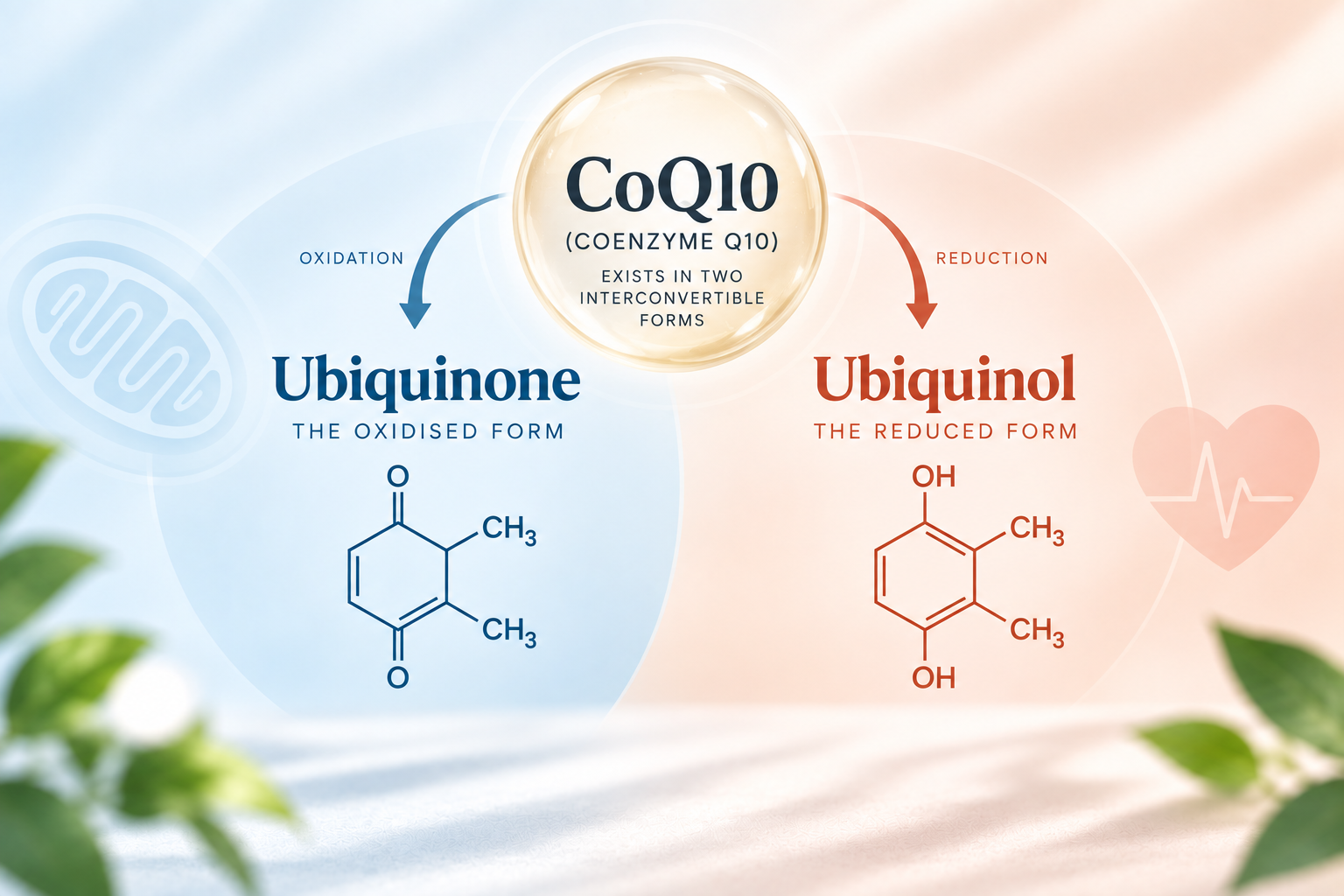
They are often marketed as competing ingredients, but they are actually two forms of the same essential coenzyme: Coenzyme Q10 (CoQ10).
So, which one should you choose?
Ubiquinone or Ubiquinol?
The answer may depend on factors such as your age, health status, supplementation goals, and the formulation itself.
In this guide, we’ll explain the differences between ubiquinone and ubiquinol, how they function in the body, and which form may be more suitable for different individuals.
What Is Coenzyme Q10?
Coenzyme Q10 (CoQ10) is a vitamin-like compound naturally produced by the body. It is found in virtually every cell and plays an important role in cellular energy production.
Its key functions include:
- Supporting ATP production and cellular energy
- Helping protect cells from oxidative stress
- Supporting normal heart function
- Supporting healthy muscle function
- Supporting brain health
- Contributing to healthy aging
Because organs such as the heart, liver, kidneys, and muscles have high energy requirements, they contain relatively high concentrations of CoQ10.
Why Does CoQ10 Matter?
Every day, your body converts nutrients from food into usable energy.
Much of this process takes place inside the mitochondria, often referred to as the “powerhouses” of the cell.
CoQ10 plays an essential role in the mitochondrial electron transport chain, which is involved in the production of adenosine triphosphate (ATP) — the body’s primary cellular energy currency.
CoQ10 also functions as an important antioxidant within the body.
As we age, the body’s natural production of CoQ10 may decline. Changes in CoQ10 status have been associated with factors such as:
- Reduced energy production
- Increased oxidative stress
- Muscle fatigue
- Slower recovery
- Changes in cardiovascular function
This is one reason CoQ10 has become a popular ingredient in supplements designed for energy, heart health, exercise support, and healthy aging.
CoQ10 Exists in Two Main Forms
The comparison is not technically “CoQ10 vs. ubiquinol.”
CoQ10 is the umbrella term, while ubiquinone and ubiquinol are two different forms of CoQ10.
Ubiquinone: The Oxidized Form
Ubiquinone is the oxidized form of CoQ10 and is the form traditionally used in many CoQ10 supplements.
It is highly stable and widely available, making it a popular and generally more cost-effective option.
Inside the body, ubiquinone can be converted into ubiquinol as part of the normal CoQ10 redox cycle.
Ubiquinol: The Reduced Form
Ubiquinol is the reduced form of CoQ10.
It is the form that can act directly as an antioxidant and participates in protecting cellular components from oxidative damage.
However, ubiquinol is more susceptible to oxidation than ubiquinone, making it more challenging to manufacture and stabilize in supplement formulations.
The body continuously converts between ubiquinone and ubiquinol according to its metabolic and cellular needs.
Ubiquinone vs. Ubiquinol: Key Differences
Feature | Ubiquinone | Ubiquinol |
CoQ10 form | Oxidized | Reduced |
Common supplement form | Yes | Yes, but generally less common |
Stability | Highly stable | More susceptible to oxidation |
Conversion in the body | Can be converted to ubiquinol | Can be converted back to ubiquinone |
Antioxidant activity | Participates after conversion to reduced form | Direct antioxidant form |
Cost | Generally more affordable | Typically more expensive |
Does Ubiquinol Work Better Than Ubiquinone?
Not necessarily.
The body naturally converts between ubiquinone and ubiquinol as part of normal cellular metabolism.
For healthy individuals, ubiquinone supplementation can effectively contribute to the body’s overall CoQ10 pool.
However, some studies suggest that ubiquinol supplementation may produce higher circulating CoQ10 concentrations in certain individuals or under certain conditions.
Factors that may influence CoQ10 status and metabolism include:
- Age
- Oxidative stress
- Certain health conditions
- Individual differences in absorption and metabolism
- Certain medications, including statins
This does not mean ubiquinol is automatically the better choice for everyone.
The actual performance of a supplement can also depend heavily on its formulation, dosage, delivery system, and how it is consumed.
Benefits Shared by Both Forms
Once incorporated into the body’s CoQ10 pool, both ubiquinone and ubiquinol participate in the same essential biological system.
Supports Heart Health
The heart has one of the highest energy demands in the body.
CoQ10 supports mitochondrial energy production and normal cardiovascular function, which is why it is commonly included in heart health formulations.
Supports Cellular Energy Production
CoQ10 plays an essential role in the production of ATP.
Healthy mitochondrial function and efficient energy production are important for:
- Daily vitality
- Physical performance
- Muscle function
- Exercise capacity
Provides Antioxidant Support
CoQ10 participates in the body’s antioxidant defense system.
In its reduced form, ubiquinol can help protect cellular structures from oxidative stress and may also contribute to the regeneration of other antioxidants, including vitamin E.
Supports Healthy Aging
The body’s CoQ10 status may change with age.
Maintaining adequate CoQ10 levels may support cellular energy production and antioxidant defenses as part of a healthy aging strategy.
May Support Exercise and Recovery
CoQ10 supplementation has been studied for its potential role in exercise performance, oxidative stress, and muscle recovery.
Results may vary depending on the population, dosage, exercise intensity, and formulation used.
Who May Consider Ubiquinol?
Although both forms can be effective, ubiquinol may be considered by individuals who:
- Are older adults
- Prefer the reduced form of CoQ10
- Are looking for a premium CoQ10 product
- Have specific health concerns and are supplementing under healthcare guidance
- Want a formulation positioned around enhanced bioavailability
People taking medications or managing health conditions should consult an appropriate healthcare professional before starting a supplement.
Who May Prefer Ubiquinone?
Ubiquinone may be particularly suitable for:
- Healthy adults seeking daily CoQ10 supplementation
- Individuals looking for a more cost-effective option
- Consumers who prefer a well-established and highly stable form
- Brands developing accessible CoQ10 formulations
For many consumers, a well-formulated ubiquinone supplement can be an excellent choice.
Which Form Has Better Absorption?
This question is more complicated than simply saying that one form is always absorbed better.
Absorption can be influenced by several factors, including:
- Formulation technology
- Oil carrier
- Dosage
- Softgel or delivery system
- Meal composition
- Individual digestive function
Because CoQ10 is fat-soluble, taking it with a meal containing dietary fat may help improve absorption.
A high-quality ubiquinone formulation may perform differently from a poorly formulated ubiquinol product — and vice versa.
For this reason, formulation quality should be considered alongside the choice between ubiquinone and ubiquinol.
Can the Body Convert Between Ubiquinone and Ubiquinol?
Yes.
The body continuously cycles between the two forms:
- Ubiquinone can be reduced to ubiquinol
- Ubiquinol can be oxidized back to ubiquinone
This reversible process is part of normal cellular metabolism.
Rather than functioning as two completely separate nutrients, ubiquinone and ubiquinol work together as part of the body’s overall CoQ10 redox system.
Tips for Choosing a High-Quality CoQ10 Supplement
Not all CoQ10 supplements are formulated in the same way.
When selecting a product, consider:
- The form of CoQ10 used
- Ingredient quality and supplier reliability
- Dosage per serving
- Oil-based or other absorption-enhancing delivery systems
- Stability of the finished formulation
- Manufacturing and quality standards
- Availability of appropriate testing and documentation
For supplement brand owners, choosing between ubiquinone and ubiquinol should involve more than simply comparing ingredient prices.
Considerations may include:
- Target consumer demographic
- Product positioning
- Price point
- Desired dosage
- Delivery format
- Ingredient stability
- Regulatory requirements
- Scientific substantiation and marketing strategy
A mainstream daily wellness product may benefit from the cost-effectiveness and stability of ubiquinone, while a premium healthy-aging or cardiovascular formula may be positioned around ubiquinol.
Frequently Asked Questions
Is ubiquinol stronger than ubiquinone?
Not exactly.
Ubiquinol is the reduced form of CoQ10 and can act directly as an antioxidant. However, the body naturally converts between ubiquinol and ubiquinone, and both forms contribute to the overall CoQ10 pool.
The best choice depends on individual needs and the quality of the formulation.
Can I take CoQ10 every day?
CoQ10 is commonly used as a daily dietary supplement. Because it is fat-soluble, taking it with a meal containing fat may support absorption.
Always follow the product directions and seek professional advice if you are taking medications or have underlying health conditions.
Which form is better for healthy adults?
For many healthy adults, ubiquinone can be an effective and cost-efficient option for daily supplementation.
Why is ubiquinol more expensive?
Ubiquinol is generally more expensive because it is more susceptible to oxidation and can require additional formulation and stabilization technology.
Is CoQ10 the same as ubiquinone?
Not exactly.
CoQ10 is the general term for coenzyme Q10, while ubiquinone is the oxidized form of CoQ10 and ubiquinol is the reduced form.
Therefore, when comparing the two supplement forms directly, “ubiquinone vs. ubiquinol” is the more scientifically precise comparison.
Final Thoughts
Ubiquinone and ubiquinol are not two completely different nutrients competing against each other. They are two forms of the same essential coenzyme, CoQ10, and the body naturally converts between them as part of normal cellular metabolism.
For many healthy adults, ubiquinone offers a stable, well-established, and cost-effective option for daily CoQ10 supplementation.
Ubiquinol, the reduced form, may appeal to consumers seeking a premium CoQ10 product or those who prefer this particular form based on their individual needs and health circumstances.
Ultimately, the choice should not be based solely on the idea that one form is universally “better.”
Age, health status, dosage, formulation quality, absorption, product positioning, and individual goals all matter.
Whether you choose ubiquinone or ubiquinol, selecting a high-quality and well-formulated CoQ10 supplement is just as important as selecting the form itself.