


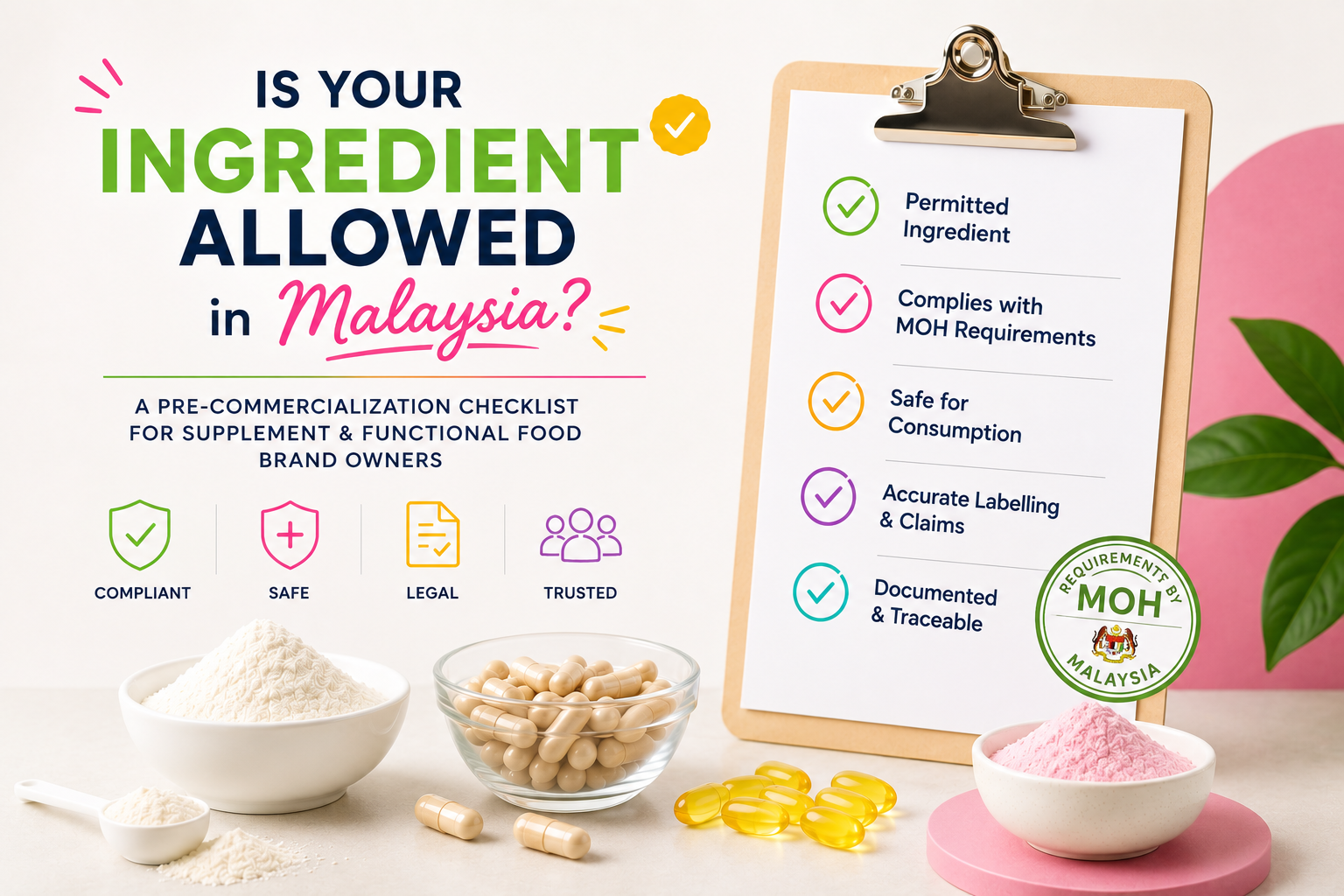
In today’s fast-moving wellness market, discovering new ingredients has never been easier.
A quick search online can introduce brand owners to trending ingredients from all over the world – whether it is Japanese beauty actives, European botanical extracts, American longevity compounds, or emerging microbiome innovations.
Naturally, many entrepreneurs get excited.
Questions such as:
“This ingredient is trending in the US, can we launch it in Malaysia?”
“Our supplier says this ingredient is clinically studied, can we use it?”
“Our competitor is using it overseas, can we commercialize it here?”
…come up more often than you might think.
But here is an important reality every brand owner should understand:
Just because an ingredient is popular globally does not automatically mean it is commercially suitable in Malaysia.
Before investing in formulation, packaging, marketing, or inventory, one of the smartest questions to ask is:
Is this ingredient actually suitable for commercialization in Malaysia?
The answer often depends on more than the ingredient itself.
It depends on classification, intended use, dosage, product claims, supporting documents, and your commercialization pathway.
So before developing your next supplement or functional food product, here is a practical checklist every brand owner should know.
Step 1: Understand Your Product Classification First
Before evaluating any ingredient, the first question should not be:
“Is this ingredient good?”
The first question should be:
“How will this product be classified?”
In Malaysia, product classification can influence which regulatory pathway your product may follow.
For example:
Health Supplements
Products positioned as health supplements may involve regulatory considerations under the National Pharmaceutical Regulatory Agency (NPRA).
These may include products in formats such as:
- capsules
- tablets
- sachets
- powder blends
Food or Functional Food Products
Products such as functional gummies, wellness beverages, nutrition powders, and certain food-based innovations may fall under requirements managed by the Food Safety and Quality Division, commonly known as BKKM.
The same ingredient may be viewed differently depending on product classification.
That is why classification should always come first.
Step 2: Is the Ingredient Suitable for the Malaysian Market?
Many ingredients gain popularity overseas before entering local commercialization discussions.
Examples may include:
- Nicotinamide Mononucleotide (NMN)
- Resveratrol
- Ashwagandha
- specialty mushroom extracts
- microbiome ingredients
- advanced botanical actives
These ingredients may have exciting market potential.
But important questions still need to be asked:
- Is the ingredient commercially suitable for your intended product category?
- Does the ingredient fit your product classification?
- Does the dosage align with your intended positioning?
- Does the ingredient have the right supporting documentation?
Ingredient popularity should never replace technical evaluation.
Step 3: Does Your Supplier Have the Right Documentation?
Even a strong ingredient can become a commercialization challenge if supporting documents are incomplete.
Brand owners should evaluate whether suppliers can provide documentation such as:
- product specifications
- manufacturing information
- safety documentation
- technical data sheets
- origin information
- stability information
- laboratory testing documentation
One of the most common reasons projects slow down is not the ingredient itself – It is missing paperwork.
Documentation matters.
Step 4: Does the Ingredient Fit Your Claims?
Another common mistake:
Choosing ingredients first…
Then trying to build marketing claims later.
Instead, brand owners should ask:
“Can this ingredient realistically support our intended product positioning?”
For example:
If your positioning focuses on:
- skin health
- digestive wellness
- active ageing
- immune support
- sports recovery
…the formulation should logically support that story.
Claims, formulation, and compliance should move together.
Step 5: Is the Ingredient Technically Suitable for Your Delivery Format?
Not every ingredient works in every dosage form.
For example:
Heat-sensitive ingredients such as certain strains of Probiotics may require careful planning if used in:
- functional beverages
- gummies
- high-moisture applications
Ingredients with strong bitterness or metallic notes may create challenges in:
- sachets
- chewables
- functional foods
An ingredient may look attractive on paper – But technical compatibility matters.
Step 6: Is the Ingredient Commercially Sustainable?
Some ingredients may look exciting during formulation…
But create long-term challenges such as:
- unstable pricing
- supply shortages
- long lead times
- inconsistent quality
- single-source dependency
Before commercialization, brand owners should ask:
“Can we scale this product if market demand grows?”
A successful formula should not only launch well – It should grow well.
Step 7: Will the Ingredient Still Be Relevant in Two Years?
Trend-driven ingredients can generate attention.
But not every trend creates lasting business opportunities.
Brand owners should consider:
- consumer awareness
- long-term market demand
- scientific credibility
- repeat purchase potential
- competitive differentiation
Sometimes the most commercially successful ingredients are not the newest—They are the most strategically positioned.
Common Mistakes Brand Owners Make
Some of the most common mistakes include:
- Choosing ingredients based on social media trends
- Copying overseas formulas without local evaluation
- Falling in love with ingredients before understanding classification
- Prioritizing marketing before documentation
- Ignoring technical compatibility with the chosen dosage format
- Assuming “clinically studied” automatically means commercially ready
Successful products are built through evaluation—not excitement alone.
Final Thoughts
In today’s supplement and functional food industry, ingredient discovery is easy.
Commercializing the right ingredient is where real expertise matters.
Before investing in formulation, packaging, or marketing, brand owners should evaluate:
- classification
- compliance
- technical feasibility
- documentation
- market relevance
- long-term scalability
The best ingredients are not always the trendiest.
They are the ones that align with your product, your market, and your long-term brand strategy.
At Novaxis Health, we work with brand owners to evaluate ingredients from both technical and commercial perspectives—helping turn product concepts into market-ready supplements and functional food innovations.