


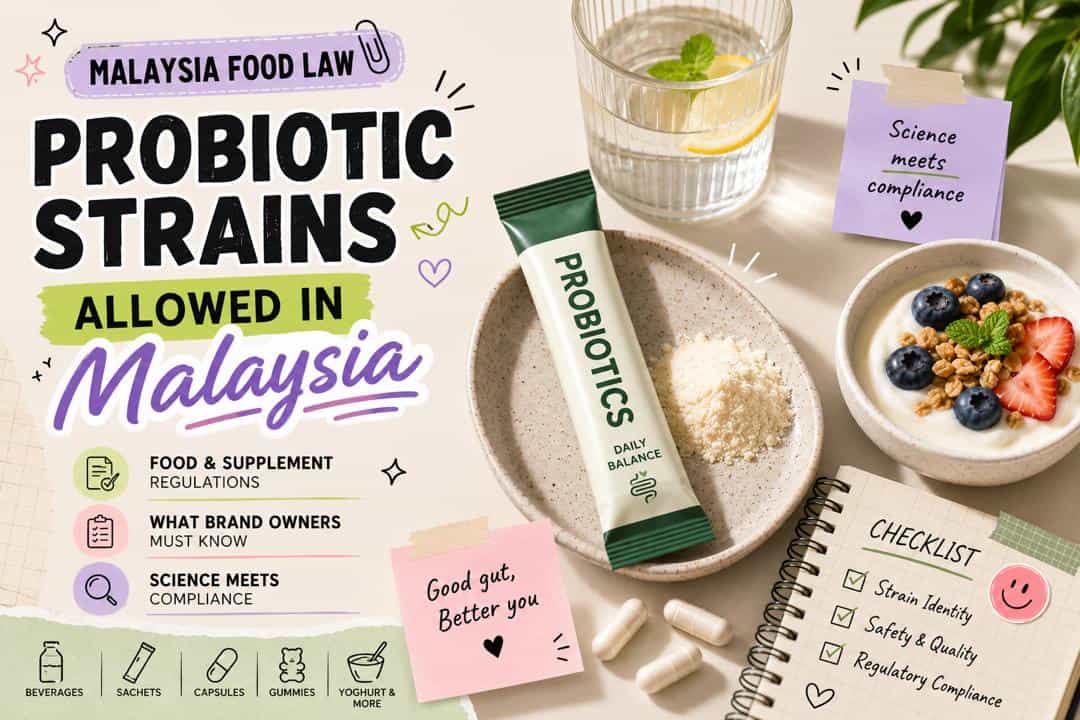
In recent years, probiotics have become one of the most requested functional ingredients in digestive health, immunity, women’s wellness, children’s nutrition, and beauty-from-within products. However, in Malaysia, not every probiotic strain can simply be added into a food or beverage and sold commercially.
For brand owners, importers, and product developers, understanding Malaysia’s probiotic regulations is essential before finalising a formulation. Choosing the wrong strain could lead to reformulation, delayed product launch, relabelling issues, or regulatory rejection.
This article explains what probiotic strains are allowed under Malaysian food law, how probiotics are regulated, and what manufacturers should check before bringing a probiotic product to market.
Who Regulates Probiotics in Malaysia?
In Malaysia, probiotics may fall under two different regulatory pathways:
- Food Products
Regulated under the Food Act 1983 and Food Regulations 1985 by the Food Safety and Quality Division (FSQD), Ministry of Health Malaysia. - Health Supplements
Regulated by the National Pharmaceutical Regulatory Agency (NPRA).
This distinction is extremely important because the same probiotic ingredient may face different compliance requirements depending on product classification.
Are All Probiotic Strains Allowed in Food?
No.
Malaysia only permits specific probiotic cultures for use in foods and beverages. Industry references indicate that 33 probiotic strains are currently permitted for food applications in Malaysia.
These permitted strains mainly come from two major groups:
Lactobacillus Group
Examples include:
- Lactobacillus acidophilus
- Lactobacillus casei Shirota
- Lactobacillus rhamnosus
- Lactobacillus plantarum
Bifidobacterium Group
Examples include:
- Bifidobacterium bifidum
- Bifidobacterium longum
- Bifidobacterium animalis subsp. lactis
One common mistake is assuming that declaring only the species name is enough. In reality, regulators often require identification at genus, species, and strain level.
For example:
✅ Correct: Lactobacillus rhamnosus GG
❌ Incomplete: Lactobacillus rhamnosus
Strain-level identification matters. Different strains under the same species may have different safety profiles, stability, and scientific evidence.
Malaysia’s Probiotic List Continues to Evolve
Malaysia continues to review and update its list of accepted probiotic cultures as scientific evidence grows. Recent updates have included strains such as:
- Lacticaseibacillus paracasei Shirota
- Lactiplantibacillus plantarum 299v
This means brand owners should never rely solely on old ingredient lists or overseas product labels. A strain accepted in Europe, Japan, Korea, or the United States may not automatically be accepted in Malaysia.
Food vs Health Supplement: Why It Matters
The same probiotic ingredient may face very different regulatory requirements depending on the final dosage form.
Food Products
Examples include:
- Probiotic drinks
- Yoghurt
- Gummies
- Jelly sticks
- Fermented milk
- Powder beverage sachets
These generally follow food regulations and must use permitted probiotic cultures.
Health Supplements
Examples include:
- Capsules
- Tablets
- Stick packs
- Sachets
These may fall under NPRA registration, which often requires additional safety documentation.
Common Mistakes Brand Owners Make
- Choosing a Strain Based Only on Marketing – A strain may be trending globally, but
- Declaring Only Species, Not Strain – Incomplete strain identification can delay registration or require relabelling.
- Ignoring Stability Data – Probiotics are live microorganisms, and the claimed CFU (colony-forming units) count should remain valid throughout the product’s shelf life, not only at the time of production.
- Using Overseas Labels Directly – Imported formulas often require Malaysia-specific compliance review before commercialisation.
What Documents Should Brand Owners Prepare?
Before launching a probiotic product in Malaysia, it is good practice to prepare:
✔ Strain identification documents
✔ Certificate of analysis (COA)
✔ Strain origin documentation
✔ Viability / CFU data
✔ Shelf-life stability studies
✔ Safety studies
✔ Antibiotic resistance data
✔ Manufacturing documentation
Having complete documentation early can significantly reduce delays during product development and compliance review.
Business Opportunities in Probiotic Product Development
Consumer demand for probiotics is expanding beyond digestive health into:
- Immunity support
- Women’s wellness
- Children’s health
- Skin health and beauty
- Sports recovery
- Healthy ageing
This creates exciting opportunities for brand owners to innovate with:
- Synbiotics
- Postbiotics
- Multi-strain blends
- Beauty probiotics
- Children’s probiotic sachets
- Functional beverages
However, regulatory compliance should always come before marketing claims.
How Novaxis Supports Probiotic Product Development
At Novaxis, probiotic product development starts with regulatory compatibility – not just ingredient selection.
Our team supports brand owners with:
✔ Ingredient screening
✔ Formulation review
✔ Product classification guidance
✔ Dosage format selection
✔ Compliance documentation support
✔ OEM and private label development
Whether you are planning a probiotic beverage, sachet, gummy, tablet, or capsule, choosing the right probiotic strain from day one can save months of reformulation, relabelling, and regulatory delays.
Planning a probiotic product for the Malaysian market? Start with the strain – not just the label. Talk to Novaxis today.